

By Barnard Crespi | Datatel Payment Technologies – Intelligence Desk
Every month, thousands of customers pick up the phone to pay a utility bill. They do not wait on hold. They do not navigate a phone tree to reach an agent. They hear their balance, confirm a payment, and hang up – often in under three minutes. The transaction is done. The revenue is collected. Nobody had to staff a call center to make it happen.
This is the modern IVR payment system at work. And for the organizations properly deploying it, the results are striking.
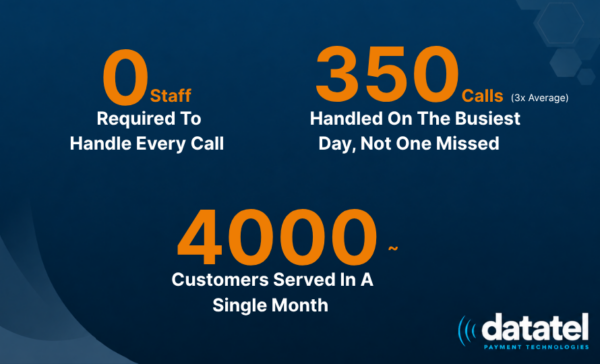
– Nearly 4,000 Customers Served In A Single Month
– Zero Staff Required To Handle Every Call
– Nearly 350 Calls ( 3x Average) Handled On The Busiest Day, Not One Missed
A detailed look at one month of live payment data drawn from a public utility serving a medium customer base reveals a system quietly delivering at scale: nearly 7,000 calls handled in a month, nearly $80,000 in revenue collected, and thousands of customers served without a single human agent involved. The data tells a story of automation that genuinely works and a platform with meaningful room to grow even stronger.
The Numbers Tell The Story
| Metric | Value |
|---|---|
| Total inbound calls (February 2026) | Nearly 7,000 |
| Revenue collected | Nearly $80,000 |
| Peak daily capacity handled | Nearly 350 calls in a single day |
In a single month, the system processed thousands of transactions without a queue, without escalations, and without a staffing budget. For a public utility organization managing tight operational margins, that is not just a minor efficiency gain it is a structural advantage.
A System Built for Scale
When a customer calls in to pay, they move through what payment technologists call a self-service funnel. This is a seven-step journey from first ring to approved transaction:
Call Received → Language Selected → Account Verified → Balance Presented → Pay Now Selected → Amount Confirmed → Payment Approved
What makes this architecture powerful is its consistency. Every customer gets the same experience, at any hour, on any day, with zero variance in quality. No tired agents, no misenteredamounts, and no transfers. The system handles a Monday morning rush the same way it handles those on a quiet Sunday night.
On the busiest single day in February, the system fielded nearly 350 calls without degradation. That kind of elastic capacity is simply not achievable with a human-staffed payment line at comparable cost.
A Channel That Works in Two Languages
Approximately 94% of customers engaged in English, with around 6% choosing Spanish representing nearly 5,000 Spanish-language interactions annually. The system’s ability to serve customers in their preferred language, automatically and without routing delays, is a capability that delivers real value both operationally and in terms of customer experience.
Organizations that invest in ensuring both language tracks perform at equal quality have an opportunity to extend the system’s reach and its revenue contribution across their full customer base.
Built For Peak Demand
Daily call volume in February ranged from a low of under 100 to a peak of nearly 350, a significant swing that reflects the natural rhythm of a billing cycle. Spikes around statement dates, payment deadlines, and service notices are absorbed automatically. The system handled every one of those peaks without a missed call or a failed transaction.
This kind of surge resilience is one of the platform’s most underappreciated strengths. When demand spikes are precisely when collection matters most, having a system that scales automatically rather than a call center scrambling to add staff is a genuine competitive advantage.
What The Data Makes Possible
The real power of a modern IVR Payment platform is not just what it does today it is the intelligence it generates for tomorrow. Monthly funnel data shows exactly where customers are engaging, where they are pausing, and where small refinements will produce the largest revenue gains.
Organizations using this data actively tracking funnel performance step by step, monitoring language-segment conversion, analyzing card mix trends are the ones turning a good self-service channel into a great one.
The infrastructure is in place. The customers are calling. The data is there. The opportunity is in reading it.
Zooming In
Thousands of customers paid their bills in February without waiting on hold, without speaking to a staff member, and without friction. Nearly $80,000 in revenue was collected automatically. The system worked at scale, in two languages, across a full month of variable demand.
The IVR Payment channel is not a stopgap. It is a strategic asset. And for organizations that treat it as one investing in monthly analysis, prompt optimization, and funnel refinement the returns will only grow.